What Is a DOFR? The Complete Guide to DOFRs in Healthcare - Division of Financial Responsibility
The Division of Financial Responsibility decides who pays for what in delegated care. Here is what it is, why it exists, and where it quietly breaks.

A Division of Financial Responsibility, commonly called a DOFR, is a contractual schedule that defines which organization is financially responsible for categories of healthcare services within a delegated risk arrangement.
It may assign responsibility to a health plan, a medical group or independent practice association (IPA), or another organization involved in administering a defined category of services. Those assignments affect how claims are routed, adjudicated, paid, and reconciled.
A DOFR is therefore more than a contract exhibit. It is the contractual foundation for operational financial-responsibility rules.
This guide is written for the people who work with those rules: claims examiners, configuration teams, health plan delegation teams, MSO operators, IPA finance leaders, compliance teams, and executives responsible for delegated performance.
What Is a DOFR?
A Division of Financial Responsibility (DOFR) is a contractual matrix, schedule, or exhibit that allocates financial responsibility for defined healthcare service categories among parties to a delegated risk arrangement.
The DOFR is commonly associated with an agreement between a health plan and a delegated medical group, IPA, or other risk-bearing entity. Depending on the governing contract, responsibility may be assigned to:
- The medical group, IPA, or other delegated entity
- The health plan
- A specialty vendor or other organization operating under a carve-out or separate delegation arrangement
- More than one party through split, shared-risk, or exception-based provisions
The exact terminology and structure vary by contract. Some agreements use a detailed matrix. Others use schedules, exhibits, definitions, exception tables, benefit grids, crosswalks, or amendments that must be evaluated together.
A public example from Alameda County Health illustrates how a DOFR can assign responsibility across service categories and lines of business. It also demonstrates why responsibility must be interpreted from the specific governing agreement rather than assumed from general industry practice. View the Alameda County Health DOFR example.
DOFR Quick Facts
Stands for: Division of Financial Responsibility
Primary purpose: Define which organization is financially responsible for specified healthcare services
Common users: Health plans, IPAs, medical groups, risk-bearing organizations, MSOs supporting delegated entities, claims administrators, and specialty organizations
Common responsibility structures: Delegated or capitated responsibility, health plan responsibility, carve-outs, subcapitation, split responsibility, and shared-risk arrangements
Operational implementation: Claims-adjudication and core-administration platforms such as QNXT, HealthRules, Facets, EZ-CAP, Epic Tapestry, and other commercial or internally developed systems
Important limitation: A DOFR does not by itself determine medical necessity, member eligibility, covered benefits, or whether care should be delivered. Those matters depend on other contractual provisions, benefit documents, clinical policies, and applicable requirements.
How DOFRs Fit Within Delegated Risk
In a delegated risk arrangement, a health plan transfers responsibility for defined functions or healthcare costs to another organization. The delegated entity may receive a prospective payment, such as a per-member-per-month capitation payment, and accept financial responsibility for the services included within the agreed scope.
The Centers for Medicare & Medicaid Services describes risk-based arrangements as payment structures in which participating organizations may be responsible for some or all costs associated with a defined population. The precise form of financial risk varies across programs and contracts. CMS: Risk-Based Arrangements in Health Care.
Capitation is one payment method that can support these arrangements. Under capitation, an organization receives a fixed payment in advance to provide or arrange defined services for an enrolled population during a specified period. CMS: Capitation and Pre-payment.
The DOFR defines the service-level boundaries of that responsibility. It helps answer questions such as:
- Are outpatient facility services the responsibility of the plan or the delegated entity?
- Are behavioral health services included in capitation or carved out?
- Who is responsible for injectable medications?
- Does responsibility change based on place of service?
- Does an exception table override the general service category?
- Which contract version applies on the claim's date of service?
These questions cannot be answered reliably from the name of a service alone. The governing agreement, applicable amendments, service definitions, effective dates, and supporting materials determine the answer.
Who Uses DOFRs?
DOFRs are most closely associated with organizations participating in delegated managed-care arrangements. Depending on the market and contract, users can include:
- Health plans
- Independent practice associations
- Medical groups
- Risk-bearing organizations
- MSOs providing administrative support to delegated entities
- Hospitals participating in risk arrangements
- Third-party administrators
- Pharmacy, behavioral health, vision, dental, transportation, and other specialty organizations
Different teams use the DOFR for different purposes.
Claims and configuration teams translate contractual responsibility into operational rules. Finance teams reconcile capitation and claim payments. Contracting teams negotiate changes. Delegation oversight and compliance teams evaluate whether delegated functions are being administered appropriately. Executives rely on the resulting financial information to understand performance.
California formally regulates organizations that accept certain forms of professional risk as risk-bearing organizations. The California Department of Managed Health Care maintains information about RBO requirements and oversight. DMHC: Risk-Bearing Organizations.
An MSO should not automatically be treated as an RBO. An MSO may provide administrative, claims, technology, contracting, or operational services without itself accepting the financial risk defined by the underlying arrangement.
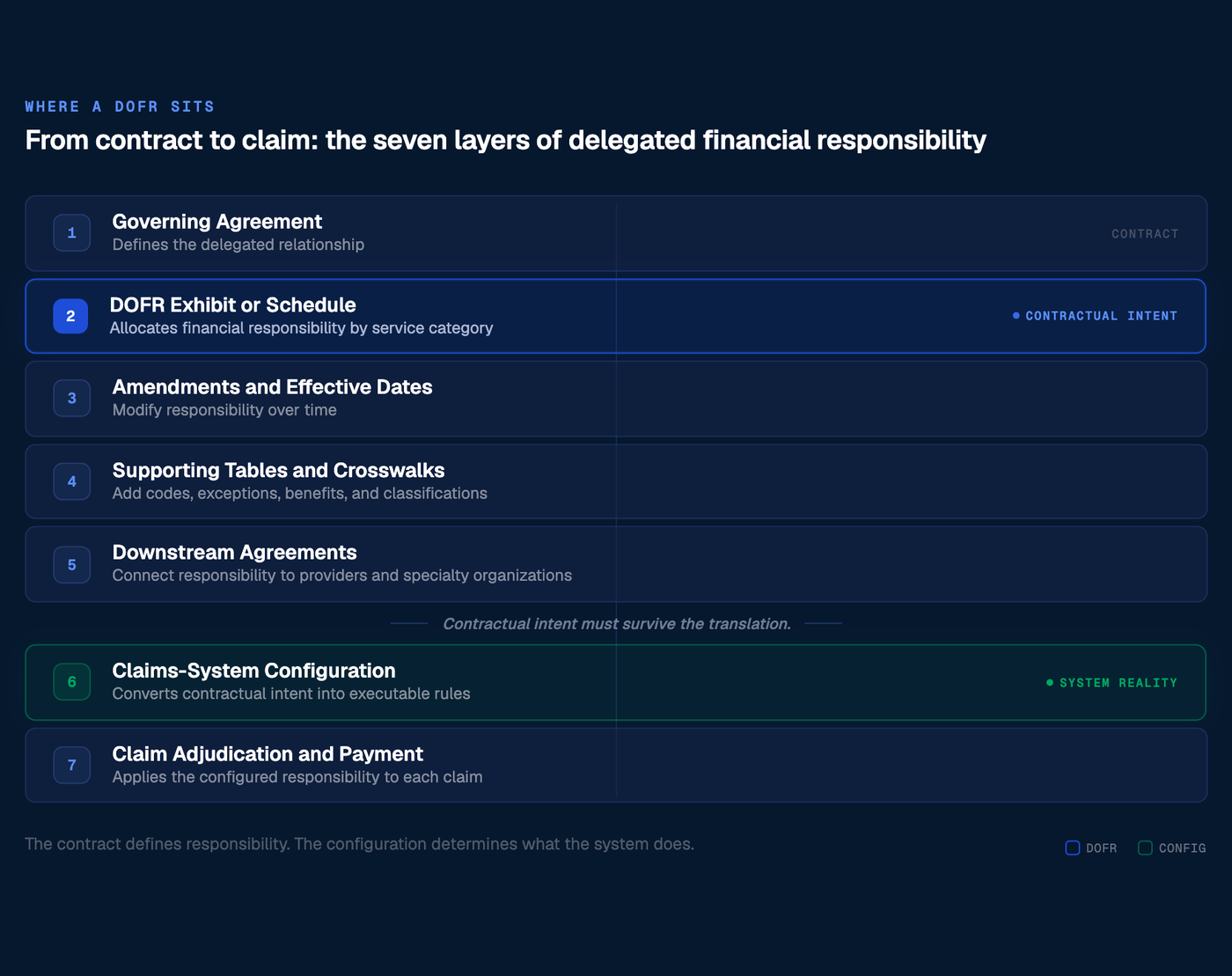
Where a DOFR Appears in the Contractual and Operational Stack
A DOFR rarely operates alone. Accurate interpretation often requires several related documents and systems.
Governing Agreement
The master, participation, provider, or delegation agreement establishes the relationship between the parties. It may define the functions being delegated, payment terms, reporting requirements, oversight rights, dispute procedures, and standards of performance.
The names and structures of these agreements vary. A Provider Participation Agreement and a delegation agreement should not be assumed to be interchangeable without reviewing the actual documents.
DOFR Exhibit or Schedule
The DOFR assigns responsibility by service category. It may be attached to the governing agreement as an exhibit, schedule, appendix, or matrix.
Amendments and Effective Dates
An amendment may change responsibility for one or more service categories, add an exception, modify a carve-out, or change the economic terms associated with the delegated scope.
The applicable rule usually depends on the contract version in force for the relevant member, product, and date of service.
Supporting Tables and Crosswalks
Some arrangements use code lists, injectable drug tables, exception tables, benefit grids, or payer-issued crosswalks to translate broad contractual categories into more specific operational classifications.
CMS updates HCPCS files quarterly, illustrating one source of coding change that organizations may need to evaluate against their contractual and operational rules. CMS: HCPCS Quarterly Update.
Downstream Agreements
Contracts with physicians, hospitals, vendors, and other downstream organizations may incorporate, depend on, or modify responsibility arrangements. They should not automatically be assumed to contain no financial-responsibility provisions.
Claims-System Configuration
The claims system applies operational rules to claim data. Those rules may be located in a dedicated DOFR module, benefit configuration, contract logic, provider configuration, custom tables, or several interconnected components.
The signed contract expresses the parties' intent. The production configuration determines what the system actually does.
Common Financial-Responsibility Models
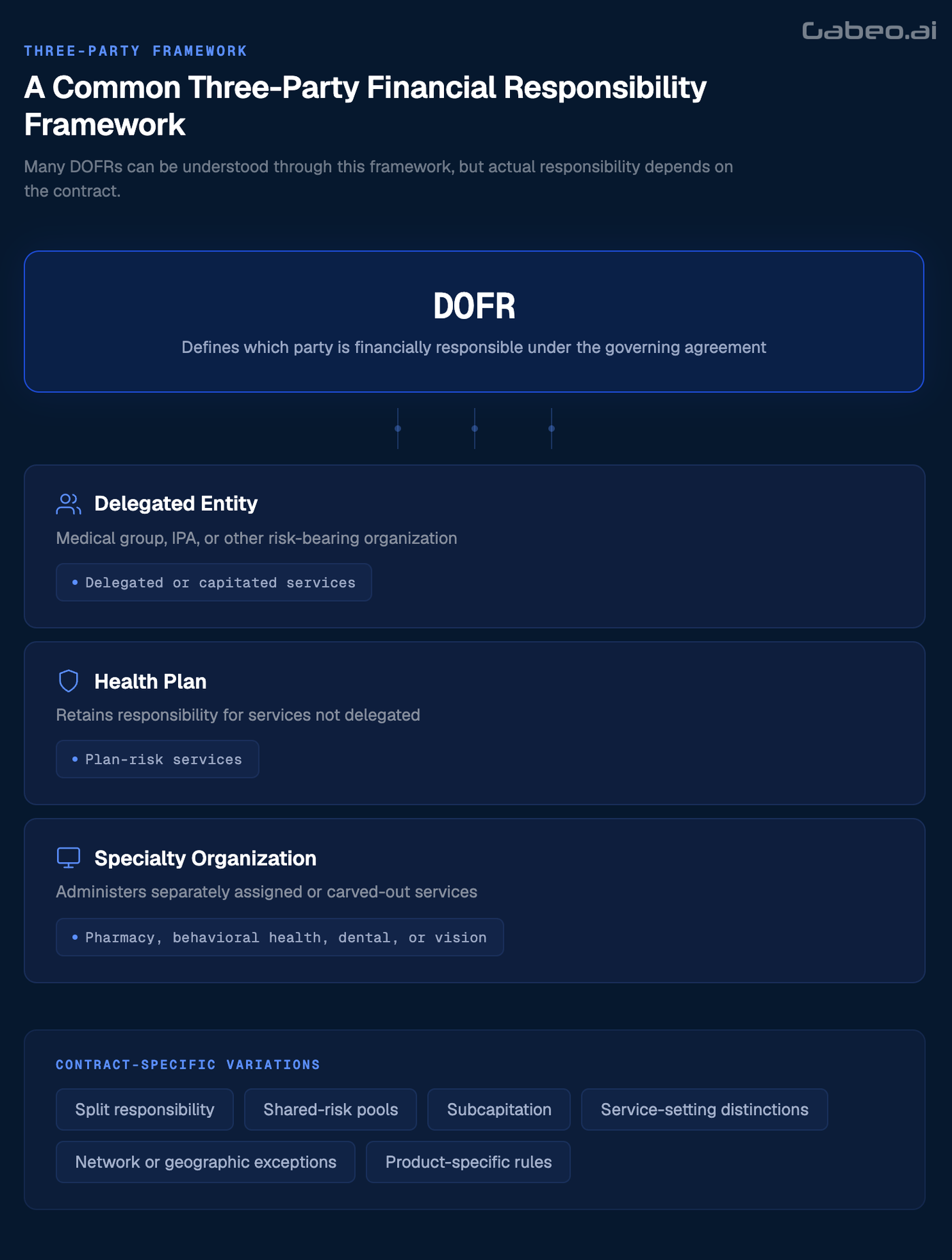
Many DOFRs can be understood through a three-party framework, although actual arrangements may include additional parties, shared responsibility, or contract-specific exceptions.
Delegated or Capitated Responsibility
The medical group, IPA, or another delegated entity accepts financial responsibility for a defined category of services. The organization may receive a prospective capitation payment intended to support those obligations.
Whether the payment is adequate and whether the organization performs financially depend on factors that can include utilization, unit cost, membership, risk adjustment, stop-loss arrangements, benefit design, and the accuracy of the responsibility assignment.
Health Plan Responsibility
The health plan retains financial responsibility for services that were not delegated under the applicable agreement.
Health plan responsibility is not necessarily the same as a carve-out. A plan may retain responsibility directly without transferring the service category to a separate specialty organization.
Carved-Out or Separately Delegated Responsibility
A category may be administered or financed through a specialty organization or separate contractual arrangement. Common examples can include behavioral health, pharmacy, dental, vision, transportation, and certain specialty services.
The precise boundary of a carve-out is contract-specific. It may depend on the service, drug, code, provider, setting, member product, or other conditions.
Split or Shared Responsibility
Some arrangements do not assign a category exclusively to one party. Responsibility may be divided by professional and facility components, network status, geography, threshold, service setting, or another negotiated condition. Shared-risk pools can also affect the ultimate economic result even when initial claim-payment responsibility is assigned to one organization.
How a DOFR Becomes Claims-System Configuration
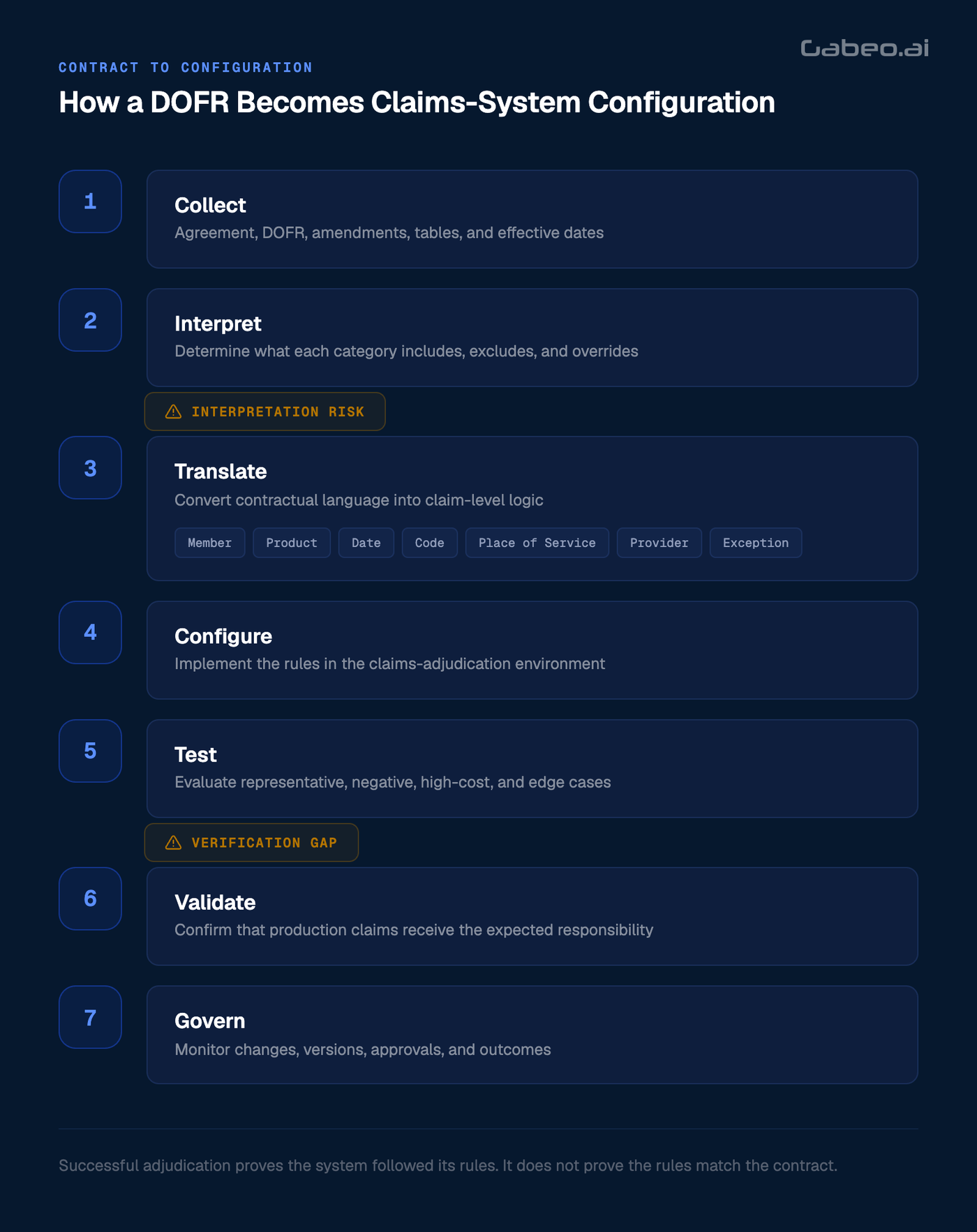
A DOFR begins as contractual language. A claims system requires structured, executable logic.
The translation commonly involves the following stages.
1. Identify the Governing Documents
The organization assembles the signed agreement, DOFR, amendments, effective dates, service definitions, exception tables, benefit materials, and relevant crosswalks.
2. Interpret the Contractual Categories
The team determines what each category includes, excludes, and overrides. Ambiguous language may require clarification from contracting, operations, clinical, legal, or payer representatives.
3. Translate the Categories Into Claim-Level Logic
Depending on the contract and platform, the logic may evaluate:
- Member and product
- Line of business
- Payer and delegated entity
- Date of service
- CPT and HCPCS codes
- Revenue codes
- Diagnosis codes
- Place of service
- Bill type
- Provider type or specialty
- Network status
- Drug or product identifiers
- Contract-specific exceptions
CMS maintains standardized place-of-service codes used on professional claims, but the contractual consequence of a place-of-service distinction still depends on the applicable agreement. CMS: Place of Service Codes.
4. Configure the Rules
The interpreted logic is implemented in the claims-adjudication environment. Responsibility rules may be distributed across multiple system components rather than stored in one obvious DOFR table.
5. Test Representative and Edge Cases
Testing should include straightforward claims, high-cost claims, ambiguous categories, exceptions, negative cases, amendments, and effective-date transitions.
6. Validate Production Outcomes
Successful deployment does not prove contractual accuracy. Organizations should verify that production claims are receiving the expected responsibility assignment.
7. Govern Ongoing Changes
Every material change should have a documented source, owner, effective date, approval, test evidence, and production-validation result.
Why DOFR Configuration Changes Over Time
DOFR administration is not a one-time implementation project.
Change can come from:
- Contract renewals
- Amendments
- Benefit changes
- Changes in delegated scope
- New or revised carve-outs
- Annual code-set changes
- Quarterly HCPCS updates
- New drugs, biologics, and biosimilars
- Revised exception tables or payer crosswalks
- Claims-platform migrations
- Provider-network changes
- New products or lines of business
The appropriate review frequency depends on the contract, source document, and operational risk. A DOFR exhibit may remain unchanged until an amendment or renewal, while a supporting code or drug table may change more frequently.
Organizations should use event-based change control and periodic verification rather than assuming every DOFR follows one universal annual or quarterly schedule.
The Invisible Failure Mode
Many claims problems generate an operational signal.
A claim may deny, reject, suspend, or enter a work queue because eligibility, authorization, coding, or required information does not satisfy the system's rules.
A DOFR configuration error can behave differently.
If the system contains a valid but incorrect financial-responsibility rule, it may execute that rule consistently. The claim can complete adjudication, the provider can be paid, and no exception may be generated.
The operational process succeeded.
The financial-responsibility assignment did not.
For example:
- The governing contract assigns a service to the health plan.
- The production configuration assigns it to the delegated entity.
- An applicable claim is received.
- The system follows its configured rule.
- The delegated entity absorbs the cost.
- No denial occurs because the configuration itself did not fail.
The discrepancy may remain hidden until someone compares the claim outcome with the governing contract, identifies an unexpected financial pattern, or performs reconciliation.
This is why a cleanly paid claim is not necessarily proof of correct financial responsibility.
High-Ambiguity Service Categories
Some responsibility questions are relatively straightforward. Others require more context than a single procedure code provides.
Common high-ambiguity boundaries include:
- Chemotherapy versus infusion therapy
- Chemotherapy versus other injectable medications
- Infusion therapy versus other injectable medications
- Diagnostic testing versus laboratory services
- Diagnostic testing versus endoscopy
- Radiation therapy versus diagnostic radiology
These are not universal DOFR categories, and they will not produce the same responsibility assignment under every contract. They are examples of boundaries where classification can depend on multiple signals.
Relevant signals may include the specific drug or procedure, clinical context, place of service, provider type, revenue code, diagnosis, contract definition, exception table, and applicable crosswalk.
The governing agreement determines which signals control the classification.
What Happens When the Contract and Configuration Disagree?
The consequences can extend beyond an individual claim.
Wrong-Party Payments
The health plan, delegated entity, or another organization may absorb a cost assigned elsewhere under the governing agreement.
Financial Leakage
Individually ordinary claims can create material aggregate exposure when the same configuration defect affects a large population or persists over time.
Reconciliation Burden
Finance and claims teams may need to reconstruct the applicable contract version, identify affected claims, calculate the financial impact, document the discrepancy, and pursue recovery.
Provider Abrasion
Responsibility disputes can create delayed payments, repeated inquiries, reprocessing, and avoidable administrative work for providers.
Reporting Distortion
Incorrect responsibility assignments can distort service-category performance, risk-pool results, utilization analysis, and forecasting.
Governance and Oversight Risk
An organization may have documented oversight processes without directly verifying that production configuration reflects the current contract.
The California Department of Managed Health Care's claims guidance illustrates the importance of documented, timely, and accurate claims-administration processes, although each organization's obligations depend on its role and applicable requirements. DMHC: Claims Technical Assistance Guidance, January 2026.
How Can an Organization Audit DOFR Configuration?
A DOFR configuration audit compares contractual intent, operational rules, and actual claim outcomes.
A practical review can include:
- Inventory active contracts and DOFRs.
- Identify amendments, effective dates, crosswalks, and exception tables.
- Determine which documents govern each product and date range.
- Translate contractual requirements into expected claim-level logic.
- Inventory the corresponding production configuration.
- Compare expected rules with configured rules.
- Test representative, high-cost, and high-ambiguity claims.
- Review successfully adjudicated claims, not only denials and exceptions.
- Quantify affected claims and financial exposure.
- Document the source and remediation for each confirmed defect.
- Validate the corrected configuration in production.
- Establish recurring and event-based monitoring.
An audit should distinguish among three separate questions:
- Completeness: Were all relevant contractual requirements translated into operational rules?
- Accuracy: Do the rules represent the contractual language correctly?
- Currency: Do the rules reflect the version applicable to the claim's date of service?
What Mature DOFR Governance Looks Like
Organizations with mature DOFR operations commonly establish the following controls.
A Defined Source of Truth
Teams know which signed documents, amendments, tables, and effective dates govern each arrangement.
Traceability
Material configuration rules can be traced to supporting contractual language or another authoritative source.
Named Ownership
The organization identifies who interprets the contract, who implements the rule, who approves it, who tests it, and who verifies the production result.
Version Control
Contracts and operational rules are maintained by trading partner, product, line of business, and effective period.
Change Control
Updates are documented, tested, approved, deployed, and validated.
Edge-Case Testing
Testing includes ambiguous boundaries, exclusions, exceptions, high-cost services, and negative scenarios.
Contract-to-Configuration Verification
Teams periodically compare production rules against governing documents instead of relying solely on the fact that claims are processing.
Outcome Monitoring
Organizations monitor financial-responsibility patterns by payer, service category, product, and responsible party to identify unexpected changes.
Efficient Reconciliation
Reconciliation confirms and quantifies discrepancies. It should not be the only mechanism capable of discovering them.
Frequently Asked Questions
What does DOFR stand for?
DOFR stands for Division of Financial Responsibility. The term can refer to the contractual exhibit itself or, more generally, to the allocation of financial responsibility within a delegated arrangement.
Is a DOFR the same as a delegation agreement?
No. A delegation agreement establishes the broader relationship between the parties and may address delegated functions, payment, reporting, oversight, performance standards, and dispute procedures. A DOFR is commonly an exhibit, schedule, or matrix associated with that agreement. It provides the more detailed allocation of financial responsibility by service category.
Who creates a DOFR?
The DOFR reflects terms agreed upon by the contracting parties, commonly a health plan and a delegated medical group, IPA, or other risk-bearing entity. Contracting, legal, finance, clinical, claims, and operations teams may contribute to its development or interpretation. The process varies by organization and agreement.
Does every delegated-risk arrangement use a DOFR?
Not necessarily under that exact name or format. Financial responsibility may be documented through a DOFR, risk matrix, responsibility schedule, contract exhibit, benefit grid, or a combination of contractual materials. The essential requirement is to identify the governing source that defines each party's obligations.
How does a DOFR affect claims?
The DOFR provides the contractual basis for determining which organization is financially responsible for a service. Claims systems operationalize that responsibility through configured rules that may evaluate codes, provider information, place of service, member product, effective dates, and exceptions. If those rules do not reflect the governing contract, a claim may process successfully while assigning its cost to the wrong party.
How often should DOFR configuration be reviewed?
Configuration should be reviewed whenever a relevant contract, amendment, benefit, code set, crosswalk, carve-out, product, or system changes. Organizations should also perform periodic verification based on contract complexity, claim volume, financial exposure, and operational risk. No single annual or quarterly schedule is appropriate for every arrangement.
What causes DOFR configuration errors?
Common causes include incomplete source documents, ambiguous contract language, missed amendments, incorrect effective dates, outdated crosswalks, manual translation errors, copied rules from another contract, undocumented overrides, staff transitions, and platform migrations. A technically valid system rule can still be contractually incorrect.
Why are DOFR errors difficult to detect?
DOFR errors may not produce denials or exceptions because the claims system is following the rule available to it. The error is the gap between that rule and the governing contract. Detection often requires contract-to-configuration comparison, analysis of financial-responsibility patterns, representative claim testing, or reconciliation.
How can an organization determine whether its DOFR is configured correctly?
The organization should compare the current governing documents with production configuration and actual claim outcomes. The review should address completeness, accuracy, currency, exceptions, effective dates, and representative edge cases. Claims that processed successfully should be included because successful adjudication does not prove correct financial-responsibility assignment.
The Bottom Line
A DOFR defines the financial boundaries of a delegated risk arrangement.
The contract says what the parties agreed to.
The configuration determines what the claims system actually does.
When those two align, claims can be assigned to the appropriate financially responsible organization. When they diverge, the system may execute the wrong rule without generating a denial or obvious operational signal.
That makes DOFR accuracy more than a contracting concern. It is a claims, finance, configuration, governance, and delegated-performance capability.
Continue Your DOFR Learning
Foundations
The Three-Way Model of Financial Responsibility
Learn how responsibility commonly divides among delegated entities, health plans, and specialty organizations.
DOFR Glossary: The Complete Reference for Delegated Risk Terminology
Explore practitioner-focused definitions for DOFRs, delegated risk, configuration governance, capitation, and claims operations.
Operational Risks
Why DOFR Errors Don't Generate Denials
Learn why an incorrect responsibility assignment can process successfully without producing a denial or work queue.
Why High-Ambiguity Categories Generate Most DOFR Misclassification Errors
Explore six service-category boundaries where accurate responsibility may depend on multiple classification signals.
Provider Abrasion and DOFR: The Hidden Source of Network Friction
See how financial-responsibility disputes can create downstream payment friction and administrative burden.
Configuration Governance
Why Static DOFR Configuration Eventually Fails
Understand how changes in contracts, codes, benefits, and operational rules can create configuration drift.
Configuration Fidelity: How to Know Whether DOFR Rules Match the Contract
Learn how completeness, accuracy, and currency support contract-to-configuration verification.
Configuration Debt in Delegated Risk Operations
Explore how undocumented rules, obsolete overrides, and institutional knowledge increase the risk of future errors.
The Delegation Oversight Blind Spot: DOFR Configuration Accuracy
Learn why configuration verification deserves a defined place within delegation oversight.
Learn More From Gabeo
Subscribe to the DOFR Benchmark Report for original research, benchmark data, and practical insights into delegated-risk operations.
Visit the Gabeo DOFR Resource Center for articles, reports, case studies, videos, and answers to common DOFR questions.
To learn how Gabeo's ARIA platform codifies contractual responsibility, evaluates paid claims, and helps organizations identify potential responsibility mismatches, explore ARIA.
Sources
- Centers for Medicare & Medicaid Services, Risk-Based Arrangements in Health Care
- Centers for Medicare & Medicaid Services, Capitation and Pre-payment
- Centers for Medicare & Medicaid Services, HCPCS Quarterly Update
- Centers for Medicare & Medicaid Services, Place of Service Codes
- California Department of Managed Health Care, Risk-Bearing Organizations
- California Department of Managed Health Care, Claims Technical Assistance Guidance, January 2026
- Alameda County Health, Division of Financial Responsibility example
Written by: Michael Riley, Co-Founder and Chief Product Officer of Gabeo.ai
Reviewed for operational accuracy by: Octavio Campos, Director of Operations at Guidant Health, with more than 20 years of DOFR experience
Last substantively reviewed: August 26, 2026
This article is educational and describes common industry structures and operational practices. Financial responsibility ultimately depends on the governing contract, amendments, applicable requirements, and current system configuration.